
It’s 10am, and the chief is late. We’ve searched his village in vain; two locals taking long, lazy puffs on filterless cigarettes tell us he might be at the church. Alain, our guide, looks flustered – he did call ahead and let the chief know we would be visiting after all. We jump in Alain’s rusting car – requisite coconut rolling around on the floor – and zip as fast as a rusting car can go up the road to the Saint Paul Church, built of pebbles stuck together with limestone. Four telecom workers sit under a tall palm tree. They’re also looking for the chief. “Seems like he is lost, not late,” says Alain.
New Caledonia’s central-east coast – a long stretch of palm-fringed beach – is home to dozens of Kanak tribes, each with their own chief. And nothing much can happen in the village without the chief’s approval. The telecom employees will have to wait until this tribe’s leader turns up to begin their work installing a village phone; we’ll have to try a different chief to get our village tour.
Island Idyll
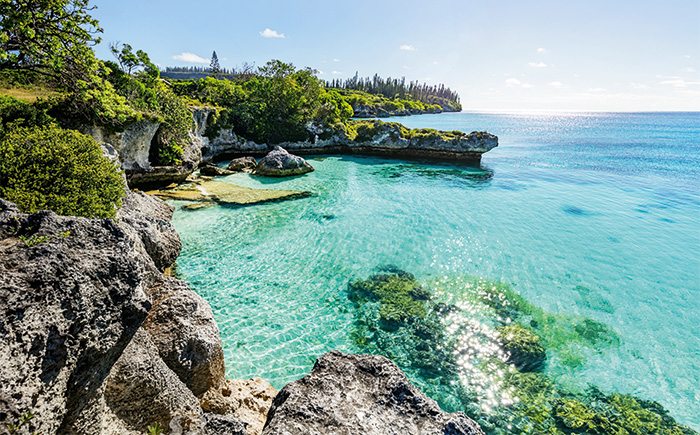
A cluster of islands in the South Pacific, around 3300km east of Australia, New Caledonia manages to squeeze an incredible amount of diversity into its landfalls. The Grande Terre is by far the largest of the islands, its terrain as varied as the shores are beautiful: from cattle-herding and French-cowboy farmland to forest-carpeted hillsides; from staggering waterfalls to craggy mountains; from sunken tree marshland to palm-lined stretches of sand. It is also one of the rare places on earth that manages to celebrate and preserve both its indigenous and colonial histories. Annexed to France in 1853, the islands became a French overseas territory in 1956; the original Melanesian inhabitants, the Kanaks, still account for around 40 per cent of the population. French is the official language, but the archipelago still supports 28 distinct Kanak languages as well as many other dialects. This can make communication between islands an interesting affair.
The unlikely union does lead to cultural whiplash at times. In restaurants, you’re just as likely to see buttery croissants and freshly made bread sticks on the menu as you are Tahitian raw fish salad and bougna, a combination of yam, banana, sweet potato, taro, manioc and perhaps chicken, all mixed with fresh coconut milk, wrapped in banana leaves and cooked under hot stones in an earthen oven until vegetables are fall-apart tender. In the supermarkets, aged French wine is as cheap as cava. And in the capital, Nouméa, dreadlocked Kanaks are as comfortable playing petanque and sipping espresso as they are freediving for fish.
Still, outside of Nouméa the vast majority of Kanak tribes subsist on hunting and small-scale farming. When we do eventually locate a – not the – village chief, he gladly shows us around his humble plot of seaside land. His thatched-roof home, with its single bed, crucifix above the door and single cabinet for clothes; his kitchen, an alfresco affair set in the shade of a pair of soaring palms; and most importantly, a hammock just steps from the water. He tells us he was born here, has lived here all his life, and will die here. He could buy a TV or move to the city but he doesn’t want to. This plot of land by the lagoon is everything.
The chief’s son lives next door, and as we stroll the coral-sand beach we see him net fishing for red snapper. He’ll share the catch with his father in return, perhaps, for some of the avocados, papaya or sweet potato that thrive in this part of the world. If you hadn’t guessed, root vegetables are a very big deal in New Caledonia. In fact, there are more than 100 different kinds of yam here, and sweet potatoes are the main Kanak commodity when it comes to gifting.
My host this trip, Nellye Kamouda, tells me that Kanak weddings can be a costly affair. When her sister got engaged two years ago, her fiancée’s entire tribe made their way from the Loyalty Islands – six coral-and-limestone islets built on top of ancient collapsed volcanoes, around 100km off the coast of Grande Terra – to Nellye’s tribe on the east coast. They came collectively, in the dozens, to ask Nellye’s father to permit the union. As is tradition, they bought bundles of sweet potatoes which Nellye and her family cooked into bougna for the three days their guests stayed. For the wedding, the situation was reversed: Nellye’s tribe made their way to the Loyalty Islands. Guests attending the wedding brought cloth and yet more sweet potatoes.
Sleepy Hamlets
Our chief’s village is in Poindimie, a laid-back coastal commune with a population of around 5000 people. Aside from Alain’s cultural tours – which end back at his home, preparing bougna and learning about other local delicacies including rousettus (flying fox), crab and lobster – the main draw of this sleepy hamlet is its marine life. Alain also leads kayaking and stand-up paddle boarding trips onto the lagoon, but I’m meeting my Aqualagoon guides Martin and Adele for a deep-water snorkelling trip. The bruised sky doesn’t spare us, and rain pelts down on the small speedboat as we zip up wetsuits, pull on flippers and masks, and slide into the water. Within minutes, we’re ogling reef sharks and turtles, giant clams and trevally, barracuda and eagle rays, drifting above eye-popping coral forming rifts, arches and canyons.
Overwater Love
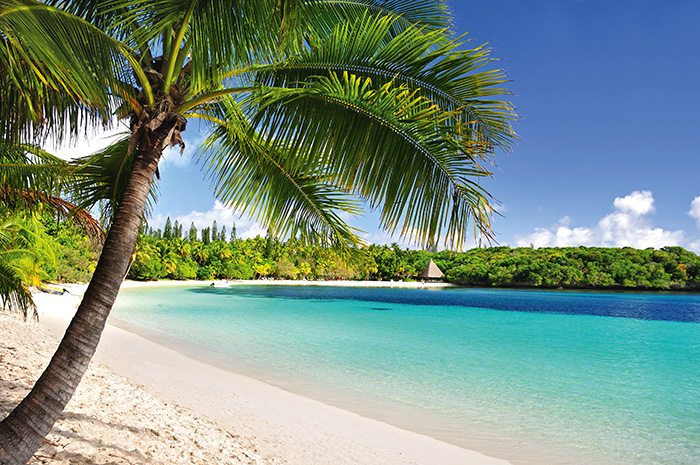
It’s a little known fact that New Caledonia is home to the largest lagoon in the world, a UNESCO-listed attraction that rings two thirds of Grande Terre, as well as the second-longest double-barrier coral reef in the world, after the Belize Barrier Reef. The marine biodiversity of the archipelago is jaw dropping: some 9000 rare and endemic species thrive here in around 23,000 square kilometres of water. The lagoon is home to major nesting sites for marine turtles and breeding areas for dugongs, humpback whales and seabirds. Glimpsed from the air it’s a coral patchwork filled with every shade of blue, from azure to turquoise, so vivid and piercing it’s as though a filter has been applied to the landscape.
I’m viewing it all from a tiny two-seat Pipistrel plane, an ultralight monoglider that takes me from Koné airfield on the west coast over an intensely hued stretch of sea and sublime lenticular reef. After a swift but essential safety briefing, (“Don’t touch anything – that’s dangerous. Also, what music do you prefer?”), we’re skimming over palm trees then mangroves on the way to the lagoon, Don’t Stop Believin’ by Journey playing through my headset. The Pipistrel dips and glides over the water, its captain pointing out sharks and clusters of manta rays among the pockets of coral. And then the Great Blue Hole, where the ocean floor sinks from 10m to 300m in an instant, creating a dramatic smudge of inky black in the middle of the azure.
The area owes a large part of its popularity to French photographer and environmentalist Yann Arthus-Bertrand, who covered two of his books, Earth from the Air and Earth from Above, with images of a natural heart formation amid emerald-green coastal vegetation, which we fly over next. A perfect heart shape formed in mangroves, La Cœur de Voh (The Heart of Voh) can also be glimpsed on a hike through Kone’s mountains, but my bird’s-eye vantage is by far the best way to take this wonder in. The flight is coming to an end, but my captain tells me that just south of here is Turtle Bay where, every year, several species of turtles nest on the beach during spawning season. Nests are tagged and guarded by volunteers, who protect the eggs until they hatch.
Capital Calling
Down on the ground in Nouméa, impossibly clear water and white, powdery shores await just a couple of kilometres off the capital’s coast. Cyrille Cottica is the owner of Aventure Marine catamarans, and he guides visitors on day trips and overnight excursions around Grande Terre’s southern tip. It takes two hours, at a very leisurely pace, to get to Amédée Island – I pass the time drinking cooled cans of surprisingly good Number One beer and eating Tahitian fish salad, which Cyrille makes by “cooking” tuna in citrus, adding in avocado, onion, cucumber and chilli. A world away from the waters of Poindimie, the shallow lagoon around Amédée is ideal for spotting green turtles and tropical fish – from the catamaran’s bow we spot at least 10 breeching turtles while anchored and eating lunch. Back on the mainland, food is a priority. With my guide for the day, Aurélie Chenu, I lap the local markets, getting inspiration for our lunchtime cooking class.
There are piles of bluespine unicornfish, prawns of every denomination, lobsters, green-fringed mussels, oysters, marlin, mahi-mahi, octopus and crab. Big, ruby-red chunks of glistening tuna occupy every other stall. Reaching jungle-fringed cooking-school-cum-boutique-hotel Lezard Home – the passion project of Sonia and Christophe Clavel – I’m happy to learn the latter will star on our menu today. Chef Christophe quit his day job as an accountant to move to the property he and his wife now call home, swapping a suit for a chef’s hat – if you’re lucky. It’s actually an informal affair – Christophe is usually barefoot in the semi-alfresco kitchen – but that’s part of the appeal. While Sonia sets chocolate mousse for dessert, Christophe deftly prepares a raw tuna salad as well as trevally en papillote, with choco, sweet potato, yam, white wine and a generous splash of vanilla oil. Laced with fragrant herbs and spices picked from the gardens, the dish is at once fresh and vibrant, mellow and zingy – a bit like New Caledonia on a plate, really.
Getting There
The international airline of New Caledonia, Aircalin, flies between Auckland, Christchurch, Wellington and Nouméa. Call 0508 247 225 or visit nz.aircalin.com. For more information on New Caledonia, visit newcaledonia.travel/nz.
Where to Stay
Le Méridien Nouméa: Newly renovated, this beachfront resort is a laid-back blend of French sophistication and warm Pacific island ambience. Overlooking Anse Vata bay – a hotspot for sunset kite surfing – the resort’s tropical gardens and fine restaurants complement spacious, light-filled rooms and suites. lemeridiennoumea.com
Sheraton New Caledonia Deva Resort & Spa: On the west coast of the main island, just south of The Heart of Voh, the resort (above) features 180 rooms and 60 bungalows designed in Melanesian style. Book a glass-bottomed boat trip to explore the stunning lagoon, or soak up views of the water from the beachside restaurant where local fish is on the menu.
sheratonnewcaledoniadeva.com
Tieti Hotel: On the east coast in Poindimie, Tieti Hotel takes its design cues from traditional Melanesian architecture, with its 10 thatched-roof bungalows facing the lagoon. Aqualagoon’s on-site headquarters makes the resort the ideal base for snorkelling and diving expeditions out to the reef and to Ilot Tibarama island, a mecca for tropical fish just five minutes offshore.
grands-hotels.nc